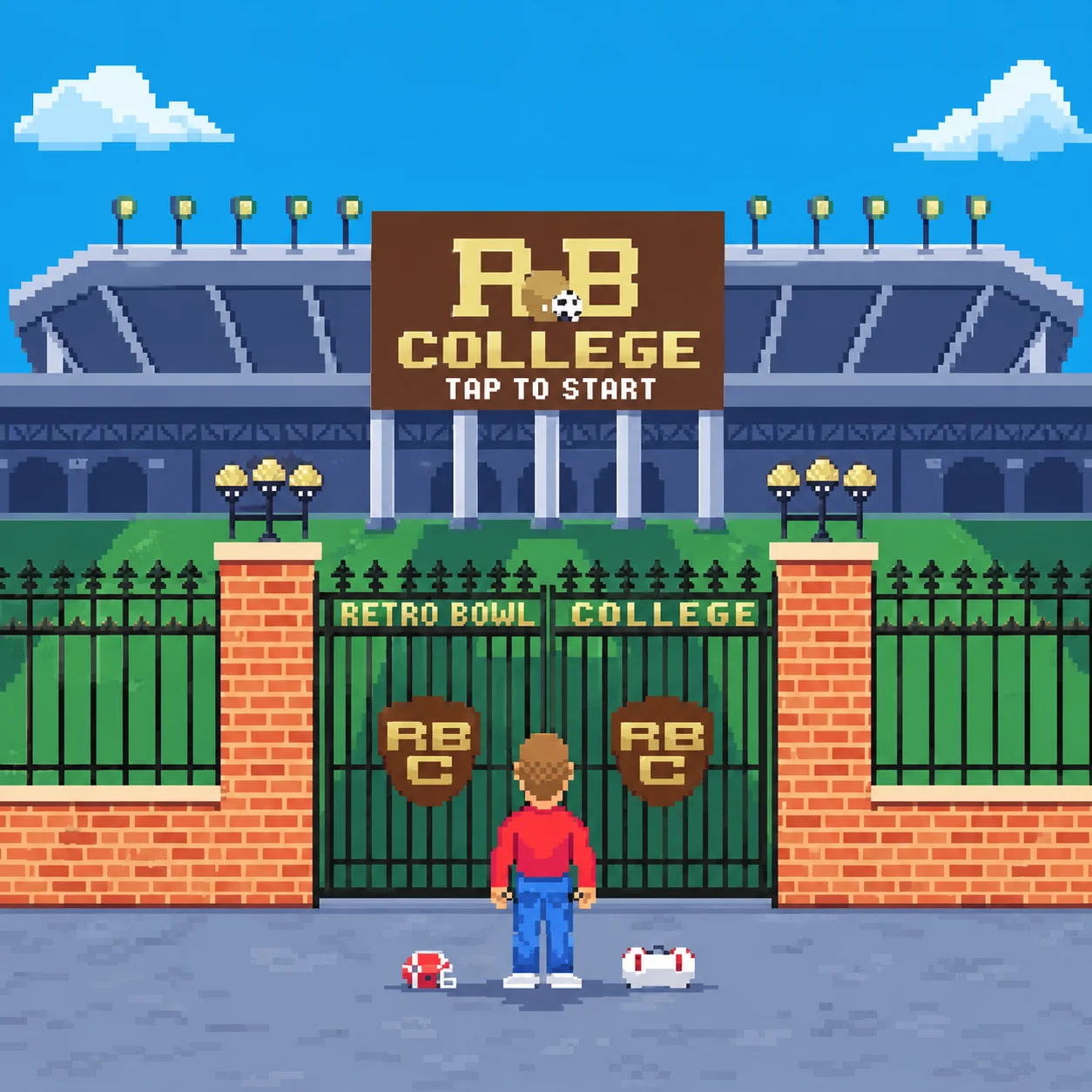
Retro Bowl College is a retro-style American football and team-management game developed by New Star Games. It is the official college football spin-off of the popular Retro Bowl.
You become the head coach of a college program and take responsibility for both on-field performance and decisions behind the scenes. Develop young players, manage limited resources, improve the team, and guide your school toward championship success.
The game combines pixel-art football action with recruiting, roster management, player development, academic responsibilities, and long-term program building.
How to Play Retro Bowl College
Begin by selecting or accepting control of a college football program. Review your roster, coaching resources, facilities, and current objectives before entering the season.
During games, control the offense by selecting plays, aiming passes, running with the ball, and deciding when to attempt a field goal or play on fourth down.
Between games, manage the roster and develop the program. Improve players, handle team issues, use the available budget carefully, and prepare for the next opponent.
Retro Bowl College Controls
Retro Bowl College Controls
Retro Bowl College: Mouse
In Retro Bowl College, navigate management menus and select options
Retro Bowl College: Hold and drag the mouse
In Retro Bowl College, aim a pass
Retro Bowl College: Release the mouse button
In Retro Bowl College, throw the football
Retro Bowl College: W and S
In Retro Bowl College, move the ball carrier up or down
Retro Bowl College: A or D
In Retro Bowl College, dive
Retro Bowl College: Mouse
In Retro Bowl College, aim and control kicks when prompted
Become a College Head Coach
Retro Bowl College gives you responsibilities beyond controlling players during matches. As head coach, you shape the direction of the complete football program.
Your decisions influence the quality of the roster, player development, team performance, and the school’s long-term reputation.
Winning games is important, but building a successful college program requires planning across multiple seasons.
Choose Your College Program
The game includes approximately 250 college teams, giving each coaching career a wide range of possible destinations.
You may begin with an underdog that needs major improvement rather than an established championship favorite. This makes every successful season feel like part of a larger rebuilding project.
Team names and visual identities may be adapted rather than officially licensed representations of real colleges.
Build an Underdog Into a Champion
A weak program will not become dominant immediately. Improve one part of the team at a time and set realistic goals for each season.
Early objectives may include producing a winning record, improving facilities, or reaching a postseason game. As the roster becomes stronger, you can pursue conference success and national recognition.
Long-term development is one of the central attractions of Retro Bowl College.
Manage Your Roster
Review each player’s position, ability, condition, morale, and development potential. A balanced roster needs more than one star offensive player.
Quarterbacks, running backs, receivers, offensive linemen, defensive players, and specialists all influence team performance.
Use limited roster spaces carefully and avoid building a team with major weaknesses in important positions.
Recruit Young Players
College football teams constantly change as players develop, graduate, or move toward professional football. Recruiting is therefore essential for maintaining the program.
Look for prospects who fill important positional needs and have enough potential to improve over time.
A highly rated recruit may be attractive, but several affordable players can sometimes create a better-balanced roster.
Develop Player Potential
Young athletes may not immediately perform at their maximum level. Experience and training help them develop their abilities.
Invest in players with strong potential and give them opportunities to improve. A prospect who appears average during the first season may eventually become one of the program’s most valuable stars.
Balance immediate performance with long-term development when evaluating the roster.
Manage the College Budget
Unlike a professional franchise, your college program operates under tight financial limitations. Every upgrade and personnel decision competes for the same resources.
Avoid spending the complete budget on one area while ignoring the rest of the team. Consider whether a facility improvement, coaching investment, or roster addition will provide the greatest benefit.
Successful budget management allows the program to improve without creating new weaknesses.
Upgrade Team Facilities
Facilities support player development, recovery, and the overall quality of the football program. Investing in them can provide benefits across several seasons.
Choose upgrades based on the team’s greatest current limitation. If players develop too slowly, training improvements may be valuable. If condition becomes a recurring issue, recovery-related facilities may deserve priority.
Facility upgrades are long-term investments rather than instant solutions.
Manage Student-Athlete Responsibilities
Retro Bowl College distinguishes itself from the professional setting by treating players as student-athletes. Team members must balance football with the demands and distractions of college life.
Academic or behavioral issues may affect availability and performance. A talented player who cannot remain eligible may become unavailable when the team needs them most.
Monitor the complete situation rather than judging players only by their athletic ratings.
Maintain Player Morale
Player morale can influence performance and team stability. Coaching decisions, playing opportunities, criticism, and off-field events may affect how athletes feel about the program.
Respond carefully when presented with a player-related decision. A choice that helps discipline the team may have a different effect on morale or public perception.
Maintaining a strong culture can be as important as improving physical attributes.
Prepare for the Professional Draft
One of your responsibilities is helping talented college players develop into professional prospects. Successful athletes may eventually declare for or enter the draft.
Losing a star creates an immediate roster problem, but producing professional-level talent reflects the strength of your program.
Plan for future departures by developing younger players before established stars leave school.
Play Offensive Possessions
During matches, you primarily control the offense. Select a play and decide whether to pass, run, or attempt a kick according to the current situation.
You do not need to control every player simultaneously. Instead, focus on the quarterback, intended receiver, or current ball carrier.
Good execution helps compensate for roster weaknesses, while poor decisions can waste even a talented offense.
Aim and Throw Passes
Hold and drag the mouse to set the direction of a pass. The aiming guide helps you determine where the football will travel.
Aim ahead of a moving receiver rather than directly at their current position. Release the mouse button when the route and throwing angle are aligned.
Consider nearby defenders before committing to the throw. An inaccurate or poorly timed pass can be intercepted.
Lead Your Receivers
Receivers continue moving along their routes after the play begins. To complete a pass, place the ball where the player will be when it arrives.
The necessary lead depends on route direction, receiver speed, and throwing distance. Longer passes require more anticipation.
Practice with different routes until you can consistently place the football away from defenders.
Run With the Football
A running play can gain reliable yardage when passing lanes are covered. Use W and S to guide the ball carrier through gaps in the defense.
Avoid moving directly into defenders. Make small directional adjustments and look for open space between blocks.
Running also helps control possession and reduces the risk of throwing an interception.
Dive for Extra Yardage
Press A or D to make the ball carrier dive. This action can help secure a first down, reach the end zone, or end the play before a dangerous collision.
Use the dive near the required yard line rather than activating it too early. Once the player dives, they can no longer change direction.
A well-timed dive can turn a short gain into a successful conversion.
Score Touchdowns
A touchdown is worth six points and provides an opportunity for an additional conversion.
Reach the end zone by completing a pass or running the football across the goal line. Red-zone space is limited, so routes develop more quickly and defenders can cover a larger percentage of the field.
Use short, accurate plays near the goal line rather than relying entirely on long passes.
Make Fourth-Down Decisions
When the offense reaches fourth down, decide whether to continue the drive, punt, or attempt a field goal when the options are available.
Playing on fourth down can preserve a scoring opportunity but may give the opponent excellent field position if the attempt fails.
Consider the distance required, current score, remaining time, and reliability of your offense before deciding.
Attempt Field Goals
Field goals provide three points and can be valuable when the offense cannot reach the end zone.
Follow the on-screen kicking indicators and use the mouse to control the attempt. Wind, distance, and timing can make longer kicks more difficult.
Do not ignore field goals when a close game can be won with a safer scoring option.
Understand Defensive Results
Defensive possessions are commonly resolved through team ratings and simulated events rather than direct player control.
A stronger defense is more likely to force punts, turnovers, or field-goal attempts. However, no rating guarantees a stop on every possession.
Improve defensive personnel and facilities so the offense does not need to win every game through constant high scoring.
Manage the Game Clock
Watch the remaining time, especially near halftime and the end of a close game.
Short passes and running plays may consume valuable seconds, while an incomplete pass can stop the clock in certain situations. Move efficiently when trailing and protect possession when leading.
Plan the entire drive rather than evaluating every play in isolation.
Read the Down and Distance
The best play depends on how many yards are needed for a new set of downs. A short-yardage situation may favor a run or quick pass.
Long-yardage situations require more ambitious routes, but forcing a deep throw into coverage may cause a turnover.
Use the information shown before each snap to select an appropriate level of risk.
Avoid Interceptions
Interceptions can end a promising drive and give the opponent an immediate possession.
Before passing, check the space between the quarterback and receiver. Defenders positioned along the projected path may reach the football first.
Throw to another receiver, use the running back, or accept a shorter gain when the deep option is unsafe.
Protect the Football
Ball security matters during both passing and running plays. Frequent hits may increase the chance of a fumble, particularly when a player is tired or has weaker attributes.
Use the dive to end a run safely when additional yardage is unlikely. Avoid forcing the ball carrier directly through several defenders.
One turnover can decide a close postseason game.
Improve Team Condition
Players become tired and may suffer injuries during a demanding season. Monitor condition before important matchups.
Training intensity can support development but may also place additional strain on the roster. Adjust your approach when several important players are struggling with fitness.
A healthy lineup is often more useful than a theoretically stronger but exhausted one.
Plan Across Multiple Seasons
College rosters experience regular turnover, so success cannot depend permanently on one group of stars.
Recruit replacements before key players depart and continue improving facilities even during a winning season.
The strongest programs create a repeatable development system rather than relying on one championship roster.
Beginner Tips for Retro Bowl College
- Complete the tutorial before beginning serious games.
- Start with short passes to learn the aiming system.
- Throw ahead of moving receivers.
- Use W and S to avoid defenders while running.
- Dive near the first-down line or end zone.
- Check the down and distance before selecting a play.
- Do not force passes into crowded coverage.
- Maintain a balanced offensive and defensive roster.
- Save resources for important team needs.
- Monitor player condition, morale, and academic eligibility.
Advanced Tips for Retro Bowl College
- Learn the timing of every receiver route.
- Use short routes to create manageable third downs.
- Run when defenders spread out to cover receivers.
- Lead fast receivers farther on deep passes.
- Protect a late advantage by controlling possession.
- Plan for player departures one or two seasons ahead.
- Invest in facilities that provide benefits across multiple recruiting classes.
- Avoid building a roster that consumes resources without covering every essential position.
- Adjust risk according to the opponent and game situation.
Common Mistakes to Avoid in Retro Bowl College
A common gameplay mistake is aiming
A common gameplay mistake is aiming directly at a moving receiver. By the time the football arrives, the player has already moved beyond that point.
Another mistake is forcing deep passes
Another mistake is forcing deep passes on every play. Short gains can keep a drive alive and create better scoring opportunities.
In management, do not ignore academics
In management, do not ignore academics, morale, condition, or future departures. A roster with excellent ratings can still fail if important players become unavailable.
Why Retro Bowl College Is Fun
Retro Bowl College combines simple retro presentation with meaningful coaching decisions. The pixel graphics are immediately accessible, but roster development and program management provide substantial depth.
On-field possessions allow you to influence important moments directly. Between games, recruiting and resource decisions determine whether the program can remain successful.
Every coaching career creates a different story as underdogs improve, stars emerge, and talented players move toward the professional draft.
Browser Game Experience for Retro Bowl College
Retro Bowl College can run directly in a compatible web browser. The desktop version uses the mouse for menus and passing, with keyboard controls for ball-carrier movement.
Click inside the game window before starting a match so the browser registers your input. Full-screen mode can provide a clearer view of routes, defenders, and management information.
Use an updated browser and avoid clearing site data if your hosted version stores career progress locally.
Game Features in Retro Bowl College
- College American football gameplay
- Head-coach career
- Approximately 250 college teams
- Retro pixel-art presentation
- Offensive play control
- Mouse-based passing
- Running and diving controls
- Field goals and fourth-down decisions
- Recruiting and roster development
- Tight budget management
- Facility upgrades
- Player morale and condition
- Academic and behavioral decisions
- Professional draft progression
- Multiple-season careers
- Browser-based play
- Single-player experience
Who Should Play Retro Bowl College?
Retro Bowl College is suitable for fans of American football, college sports, management games, retro graphics, and long-term team-building experiences.
It is particularly appealing to players who want to control important offensive possessions while also making decisions as a head coach.
This is an American football game rather than an association football or soccer title.
Retro Bowl College FAQ
What is the correct game title?
Retro Bowl College: The official title is Retro Bowl College. “Retro Bowl College Football” is a descriptive search phrase commonly used to find the game in Retro Bowl College.
Who developed Retro Bowl College?
Retro Bowl College was developed by New Star Games in Retro Bowl College.
Is Retro Bowl College related to Retro Bowl?
Retro Bowl College: Yes. It is the official college football spin-off of Retro Bowl in Retro Bowl College.
What do you do in Retro Bowl College?
Retro Bowl College: You manage a college football program, develop players, make coaching decisions, and control the offense during games in Retro Bowl College.
How many teams are available?
Retro Bowl College: The game includes approximately 250 college teams in Retro Bowl College.
How do I throw a pass?
Retro Bowl College: Hold and drag the mouse to aim, then release the button to throw in Retro Bowl College.
How do I move the ball carrier?
Retro Bowl College: Use W and S to move the player up or down in Retro Bowl College.
How do I dive?
Retro Bowl College: Press A or D to make the ball carrier dive in Retro Bowl College.
Can I control the defense?
Retro Bowl College: The standard gameplay primarily gives you direct control of offensive possessions. Defensive results are generally simulated according to team strength and game events in Retro Bowl College.
Does the game include recruiting?
Retro Bowl College: Yes. Building and developing a changing college roster is a central part of the management experience in Retro Bowl College.
Do players leave for the professional draft?
Retro Bowl College: Talented athletes can develop into professional prospects, requiring you to prepare replacements for future seasons in Retro Bowl College.
Is Retro Bowl College multiplayer?
Retro Bowl College: The standard browser experience is primarily a single-player coaching and football game in Retro Bowl College.
Can I play Retro Bowl College online for free?
Retro Bowl College: A free browser version is available through supported game platforms such as Poki in Retro Bowl College.
Do I need to download Retro Bowl College?
Retro Bowl College: No. The hosted web version runs directly inside a compatible browser in Retro Bowl College.
What is Retro Bowl College?
Retro Bowl College is a retro-style American football and team-management game developed by New Star Games in Retro Bowl College.
Final Thoughts on Retro Bowl College
Retro Bowl College expands the familiar Retro Bowl formula with recruiting, student-athlete management, limited budgets, and the constant roster turnover of college football.
Build your program carefully, develop young talent, manage off-field responsibilities, and execute important offensive possessions. Whether you rebuild an underdog or maintain a national powerhouse, every season offers another opportunity to establish your coaching legacy.